Language Distribution in Al-Hamdaniyah District, Ninawa Province, Iraq
Pages
403-440Abstract
Iraq is a linguistically diverse country where languages from several language families are spoken. Prolonged political instability has led to internal displacement and migration, making it more difficult to understand the spatial distribution of these languages. In many parts of Iraq, linguistic documentation remains limited, whether in the form of language maps or other language-related studies.
This study addresses this gap through the systematic documentation of the spatial distribution of linguistic communities in Al-Hamdaniyah District, Nineveh Province, northern Iraq. While earlier language maps relied largely on general knowledge and sources such as newspaper reports, this study combines specialized demographic and geographic records with firsthand fieldwork conducted across settlements in the district.
For data visualization, the open-source GIS software QGIS was employed. The study produced a map showing the distribution of languages in Al-Hamdaniyah District. This map contributes to a better understanding of the region’s linguistic landscape, gives greater visibility to underrepresented linguistic communities, and assists in selecting representative locations for future comparative research on linguistic features using a language-data questionnaire.
References
- References
- Allison, C. (2007). The Kurds are alive: Kurdish in Iraq. In J. N. Postgate (Ed.), Languages of Iraq: Ancient and Modern (pp. 135–158). British School of Archaeology in Iraq.
- Anonby, E., Taheri-Ardali, M., Haig, G., et al. (2020). Atlas of the languages of Iran (ALI) questionnaire [Dataset]. Borealis. https://doi.org/10.5683/SP2/SDJ5N4
- Aurenhammer, F. (1991). Voronoi diagrams — A survey of a fundamental geometric data structure. ACM Computing Surveys, 23(3), 345–405. https://doi.org/10.1145/116873.116880
- Bailey, D. (2018). A grammar of Gawraǰū Gūrānī [Doctoral dissertation, Georg-August-University Göttingen]. https://doi.org/10.53846/goediss-7061
- Blanc, H. (2024). Communal dialects in Baghdad (1st ed.). Brill.
- Creason, S. (2004). Aramaic. In R. D. Woodard (Ed.), The Cambridge Encyclopedia of the World’s Ancient Languages (pp. 391–426). Cambridge University Press.
- https://archive.org/details/cambridgeencyclo0000unse_t8o9/page/n5/mode/2up
- Dent, B. D., Torguson, J. S., & Hodler, T. W. (2009). Cartography: Thematic map design (6th ed.). McGraw-Hill Higher Education.
- Ghanim, H. (2026). Evaluation and analysis of Izady’s map of the language distribution in Iraq. [Manuscript submitted for publication]
- Ghanim, H. (2026). Mapping the languages of Ninawa Province in Iraq in 2025: An infographic. [Manuscript submitted for publication]
- Google Maps. (2021). Google Maps. https://www.google.com/maps
- Haig, G. (2018a). 2.3. Northern Kurdish (Kurmanjî). In G. Haig & G. Khan (Eds.), The Languages and Linguistics of Western Asia (pp. 106–158). De Gruyter.
- https://doi.org/10.1515/9783110421682-004
- Haig, G. (2018b). 3.3. The Iranian languages of northern Iraq. In G. Haig & G. Khan (Eds.), The Languages and Linguistics of Western Asia (pp. 267–304). De Gruyter.
- https://doi.org/10.1515/9783110421682-009
- Haig, G., & Khan, G. (Eds.). (2018). The languages and linguistics of Western Asia: An areal perspective. De Gruyter Mouton.
- Haig, G., & Öpengin, E. (2014). Introduction to special issue — Kurdish: A critical research overview. Kurdish Studies, 2(2), 99–122.
- https://kurdishstudies.net/menu-script/index.php/KS/article/view/59
- Haig, G., & Öpengin, E. (Eds.). (2014). Kurdish studies archive: Vol. 2, no. 2, 2014. Special Issue: Kurdish Linguistics. Brill. https://doi.org/10.1163/9789004706552
- Hassanpour, A. (1992). Nationalism and language in Kurdistan, 1918–1985. Mellen Research University Press.
- Hiltermann, J. R. (2007). A poisonous affair: America, Iraq, and the gassing of Halabja. Cambridge University Press.
- Human Rights Watch. (2003). Iraq: Forcible expulsion of ethnic minorities [Report].
- https://www.hrw.org/report/2003/03/13/iraq-forcible-expulsion-ethnic-minorities
- Humanitarian Data Exchange. (2021a). Administrative boundaries [Data set].
- https://data.humdata.org/dataset/cod-ab-irq
- Humanitarian Data Exchange. (2021b). Iraq – Settlements [Data set]. https://data.humdata.org/dataset/iraq-settlements
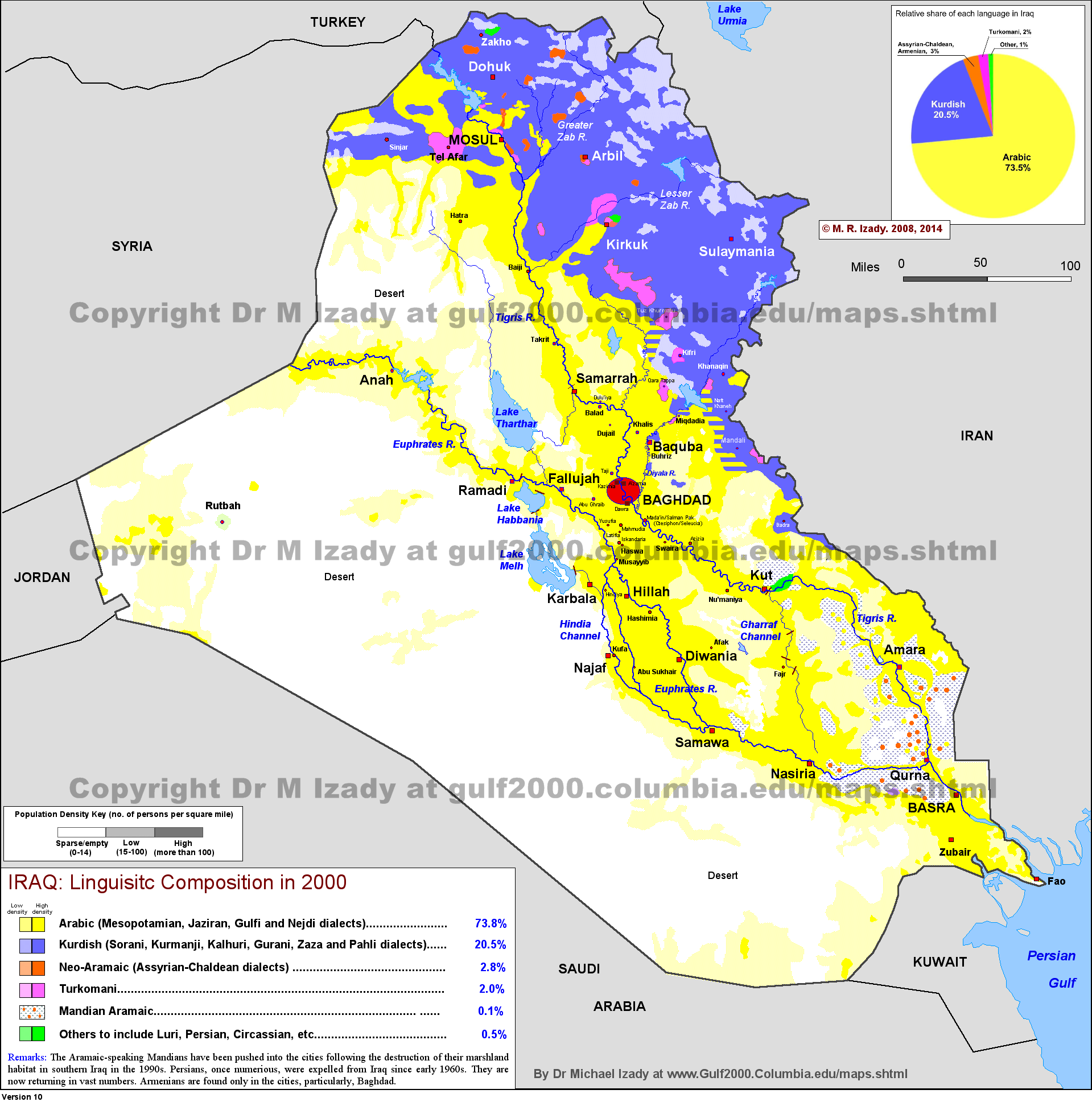
- Izady, M. (2014). Iraq: Linguistic composition in 2000 [Infographic]. School of International and Public Affairs, Columbia University.
- https://gulf2000.columbia.edu/images/maps/Iraq_Languages_lg.png
- Jastrow, O. (2006). Arabic dialects in Turkey. In M. Eid, A. Elgibali, M. Woidich, & A. Zaborski (Eds.), Encyclopedia of Arabic Language and Linguistics (Vol. 1, pp. 117–123). Brill. https://dare.uva.nl/search?identifier=316bade0-d407-4b57-bae8-c4d1f1c899f6
- Khan, G. (2007a). Aramaic in the medieval and modern periods. In J. N. Postgate (Ed.), Languages of Iraq: Ancient and Modern (pp. 95–114). British School of Archaeology in Iraq.
- Khan, G. (2007b). The north-eastern Neo-Aramaic dialects. Journal of Semitic Studies, 52(1), 1–20. https://doi.org/10.1093/jss/fgl034
- Khan, G. (2016). The Neo-Aramaic dialect of the Assyrian Christians of Urmi. Brill.
- Khan, G. (2018). 2.5. The Neo-Aramaic dialects of eastern Anatolia and northwestern Iran. In G. Haig & G. Khan (Eds.), The Languages and Linguistics of Western Asia (pp. 190–236). De Gruyter. https://doi.org/10.1515/9783110421682-006
- Leezenberg, M. (1994). The Shabak and the Kakais: Dynamics of ethnicity in Iraqi Kurdistan. ILLC Research Report and Technical Notes Series, 94–07(X), 1–19.
- https://eprints.illc.uva.nl/id/eprint/630/1/X-1994-07.text.pdf
- MacKenzie, D. N. (1956). Bājalānī. Bulletin of the School of Oriental and African Studies, 18(3), 418–435. https://doi.org/10.1017/S0041977X00087930
- Mahmoudveysi, P. (2012). The Gorani language of Gawrajŭ, a village of West Iran: Texts, grammar, and lexicon. L. Reichert.
- Mahmoudveysi, P., Bailey, D., Paul, L., & Haig, G. (2012). The Gorani language of Gawraju, a village of West Iran: Texts, grammar, and lexicon. Reichert Verlag.
- https://doi.org/10.29091/9783752005332
- McCarus, E. N. (2009). Kurdish. In G. Windfuhr (Ed.), The Iranian Languages (pp. 587–633). Routledge. https://doi.org/10.4324/9780203641736
- McDowall, D. (2021). A modern history of the Kurds (4th ed.). I.B. Tauris.
- Mutar, S. (2020). Mīsobotāmyā, mawsūʕat al-lughāt al-ʕirāqīya [Mesopotamia, Iraqi Arabic encyclopedia]. Al-Ummah al-’Iraqiya Research Centre.
- Natali, D. (2007). The Kurds and the state: Evolving national identity in Iraq, Turkey, and Iran (1st ed.). Syracuse University Press.
- Okabe, A., Boots, B., Sugihara, K., Chiu, S. N., & Kendall, D. G. (Eds.). (2000). Spatial tessellations. John Wiley & Sons. https://doi.org/10.1002/9780470317013
- Palva, H. (2009). From qəltu to gələt: Diachronic notes on linguistic adaptation in Muslim Baghdad Arabic. https://api.semanticscholar.org/CorpusID:190607438
- Paul, L. (2008). Kurdish language I: History of the Kurdish language. In Encyclopaedia Iranica (pp. 1–22). https://www.iranicaonline.org/articles/kurdish-language/kurdish-language-i/
- Postgate, J. N. (Ed.). (2007). Languages of Iraq, ancient and modern. British School of Archaeology in Iraq.
- Postgate, J. N., & Bulut, C. (2007). Iraqi Turkmen. In J. N. Postgate (Ed.), Languages of Iraq, Ancient and Modern (pp. 159–187). British School of Archaeology in Iraq.
- Procházka, S. (2018). 3.2. The Arabic dialects of northern Iraq. In G. Haig & G. Khan (Eds.), The Languages and Linguistics of Western Asia (pp. 243–266). De Gruyter.
- https://doi.org/10.1515/9783110421682-008
- QGIS Development Team. (2024). QGIS geographic information system [Computer software]. Open Source Geospatial Foundation. https://qgis.org
- Ruggles, S., Cleveland, L. L., Lovatón Dávila, R., Sarkar, S., Sobek, M., Burk, D., Ehrlich, D. E., Heimann, Q., & Lee, J. (2024). Integrated public use microdata series, international: Version 7.5 [Dataset]. IPUMS. https://doi.org/10.18128/D020.V7.5
- Thiessen, A. H. (1911). Precipitation averages for large areas. Monthly Weather Review, 39(7), 1082–1089. https://doi.org/10.1175/1520-0493(1911)39%3C1082b:PAFLA%3E2.0.CO;2
- Woodard, R. D. (Ed.). (2004). The Cambridge encyclopedia of the world’s ancient languages. Cambridge University Press.
Identifiers
Download this PDF file
Statistics
How to Cite
Copyright and Licensing

This work is licensed under a Creative Commons Attribution 4.0 International License.